| No. | Starting Value | Appreciation Value | Final Value | Period |
|---|
The home appreciation calculator is a tool used to calculate the future value of a property based on its current value, estimated annual appreciation rate, and the property holding period. The appreciation rate is the percentage rate of change by which the property value increases per unit of time. The purpose of calculating home appreciation is to understand how much a property will be worth in the future, and this will help you create an investment plan, set financial goals, and make better decisions about where to invest your wealth.
A typical real estate appreciation calculator considers three key details:
Entering these three values into the calculator will allow you to easily predict the value of your asset in the future.
The fundamental formula that is used to calculate appreciation is:
Formula
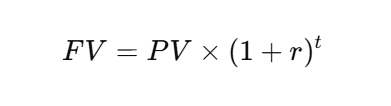
Where:
The above formula supposes that the appreciation is compounded annually, i.e., the asset's value doubles exponentially each year based on the original value as well as on the total appreciation in the past years.
Let's take an example to understand how to use the property home appreciation calculator in Excel. You have an investment property today, which is valued at $200,000, and it appreciates at a rate of 4% annually. You hold it for 10 years. Substituting this into the formula, we will be able to get the future value of the property.
Substituting these figures in the formula:
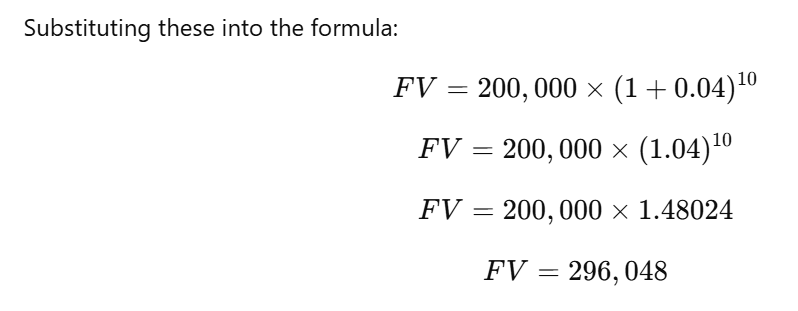
Thus, in 10 years, your property would be valued at about $296,048 when there is a steady 4% appreciation each year.
Although the concept of appreciation can be used for all types of assets, certain investments are more likely to appreciate significantly over time. Some of the most common types of appreciating assets are as follows:
Property is the most widely recognized asset that appreciates over time. Property values increase due to economic growth, increased demand, inflation, and improvements in the surrounding neighborhood. Property appreciation largely depends on the location, the state of the economy, and other local factors in that location.
Investing in stocks and bonds can also lead to asset appreciation. Stocks appreciate based on the performance of companies, dividends, and market demand. Bonds, although safer, may appreciate depending on interest rates and the issuer's credit rating.
Antiques and rare art pieces appreciate greatly over time, especially if they are highly desired or have cultural or historical significance. Items such as vintage cars, watches or works of art by famous artists can sometimes increase in value phenomenally.
A good business can provide tremendous value growth on your investment. As the company grows, so does its value, which can be capitalized on through long-term sales or continued income generation.
The most important reason to use a value appreciation rate calculator is to give you a better idea of how your investments will perform in the future. Here are some of the specific benefits of using this tool:
With the knowledge of how much your properties might be worth in the future, you can better decide what to do with your money. If you know that the value of a property is going to rise at a certain rate in the future, you can decide whether it is worth investing in it or your money can be better invested elsewhere.
Using a property appreciation calculator helps you estimate how much money you need to invest or save to achieve your financial goals. For example, if you are saving for a retirement fund and your investments are to grow by a certain percentage, you can use the calculator to estimate how much you will need to invest as well as set a time-frame in years within which you want to achieve the desired amount.
Different properties appreciate in value at different rates, and by using a home value appreciation calculator, you can calculate the opportunity for a return on investment. You have the value growth rate on a property as a percentage and can determine whether you should take the risk of investing.
Whether you are interested in investing in real estate, stocks or collectibles, the calculator can give you an estimate of the future value of your investment so that you can make more informed financial decisions.
Although the annual appreciation calculator in India is good, one must understand that its estimates are based on assumptions that may or may not happen. Following are some of its disadvantages:
Variable appreciation rate: The appreciation rate used in the calculator is usually an estimate based on the past. However, the future market environment may be different, and hence the appreciation rate may be higher or lower.
External influences: A slowdown in the economy, a change in tax policy, or even a global event can affect the appreciation rate of an asset. These are difficult for the calculator to predict.
Compounding assumptions: Most calculators compound annually, but the compounding frequency (quarterly, monthly, etc.) varies and affects the final value.
No accounting for costs: A property appreciation calculator in India usually does not take into account costs such as taxes, maintenance or transaction fees that can reduce the net value of your investment.
Using this information, let's look at how an appreciation calculator can be used in everyday life.
Online calculator: Some websites have free web-based financial calculators available, where you can enter your original amount, target return rate, and time frame to provide you with a future value calculation. Some websites include Bankrate, Investopedia, and personal finance programs.
Excel spreadsheet: Or you can create it yourself, by hand. You can create a manual calculator to forecast appreciation in Excel. The power of Excel formulas allows you to create a user-defined calculator that can accept more advanced variables, such as multiple compounding periods or differential rates of appreciation.
Financial advisor: You can hire a financial advisor to get the advice you need. Such a financial advisor will use an appreciation calculator along with other financial software to advise you about your investments.
We would love to hear your feedback. Your review will help us continue improving.
Please Review Us
Determining appreciation value of an asset or commodity requires two major pieces of information: Original value (principal) = value of the asset or cost of the asset and Second- appreciation or increased value per year by which the value of the asset will increase with respect to the additional time period, both of these will require a time frame; thus, how much the value of the asset can increase in a particular period can be calculated.
Appreciation has a positive effect on financial accounts because the value of assets increases over the long term. As soon as one owns an appreciating asset such as real estate or shares, the increase in value ultimately causes an increase in the overall net worth. This appreciation usually appears in the accounting books as an increase in the value of the asset on the balance sheet, leading to increased financial stability. Also, income can be generated in the form of capital gains by selling an appreciating asset or adding equity, which is useful for future investments or lending.
Strictly speaking, these are all ways in which the value of a property increases. An increase in demand in the market and people being willing to buy, leading to a rise in prices, is perhaps the biggest reason for appreciation of anything. For example, when the nearby economy continues to improve, or there is an increase in demand for homes in the area due to better schools and job opportunities or infrastructure development, the value of homes in the real estate market may increase further.
The appreciation of an asset is influenced by certain specific factors. The first and foremost is the economic condition of the market or the demand and supply and the market trends in general. The presence of inflationary conditions makes the value of assets like real estate and stocks increase over time. Location plays a very important role in the appreciation of assets, especially real estate. With better development and urbanization in a particular area, the appreciation rate is likely to be higher over a given period. Demand for assets, for example, a collectible or property, creates the possibility of a rapid increase in its value. Investments and improvements to an asset, such as renovations or upgrades, can increase the extent of appreciation. Lastly, changes in tax laws, interest rates or other regulatory policies by governments can affect the rate at which the value of assets is increasing.

Your Rating : Good!