Volume (gallon) and Stress (pound) are standard units of measurement in a lot of places, although they contribute to a nonconformity function. A gallon is often used to measure the total volume of a liquid, while a kilogram is used to measure the actual mass or weight of the liquid.
There are some common landscapes where it is necessary to convert liters to kilos:
In the recipes and innovations of food and beverages, there is constant switching from gallon to pound when it comes to the exact content of ingredients.
Industrial chemicals' safety and compliance rely on the accurate weighing of the runny to stay in storage or transportation.
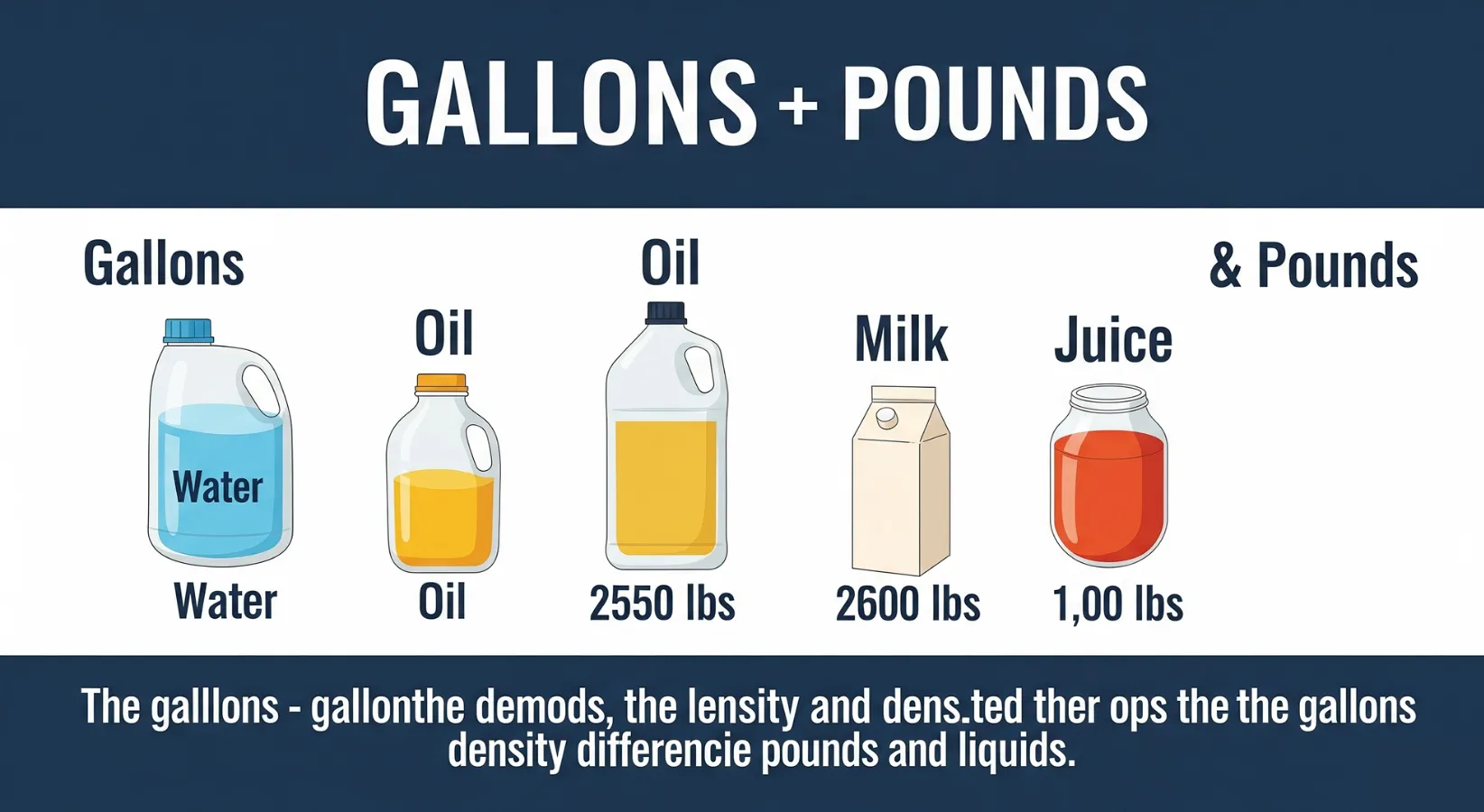
The relationship of a gallon to a pound relies on the liquid's density that you're using. That is why, even though their volume is equal, they don't behave the same.
For Instance:
A gallon of gas weighs roughly twice a gallon of sugar, as you can observe. That is, however, based on the assumption that a machine that automatically computes the weight based on the kind of fluid is used.
The calculator explains it easily. The machine does it behind your back, for example, manually checking the density of each speck, plugging it into a formula, and doing the math.
The answer is shown on the spot, indicating how many pounds your volume is.
That provides consistency and accuracy, especially in the operation of working past the deadline by alternately managing a high volume of changes.
For instance, a gallon of singular material is sure to weigh significantly more than the alternative, possibly less. Density is usually expressed in pounds per gallon (lb/gal).
When you take a gallon and convert it into a pound, you multiply the gallon until you're content with the resulting density of the liquid. It is for this reason that it is important to select the right type. The application of incorrect density provides you with incorrect mass, which can cause grave errors, especially in industrial alternatively strict applications.
Having a specialized calculator gives you a variety of advantages, such as:
This gadget contains some of the most common liquids used, and so it is useful and versatile:
Used in nearly all industries, ranging from agriculture to equipment. It's the most typical water by strain for volume conversion.
Which is required for fuel handling in transportation, shipping, and fuel maintenance.
Diesel weight matters when fuel pricing control and storage come into play, which is usually referred to in trading and industrial equipment.
Beneficial to dairy farmers, manufacturers, and food processors who have huge volumes of milk.
Another strain of sugar, which is in great demand for its high concentration of the individual. Food producers and beekeepers appreciate the accurate weights used to convert volumes.
The following are specific instances where using this converter would be appropriate:
Be sure to always convert the right type of liquid.
In case the runny does not have an entry, you should either look up its density or specific gravity and use a tailor-made calculator.
It holds in mind the potentiality of changing density, which is especially determinative for the systematic and technological purposes.
We would love to hear your feedback. Your review will help us continue improving.
Please Review Us
A gallon of water weighs close to 8.34 lbs at room temperature. This is the reference density utilized primarily for water changes.
Depending on the circulation current of humans, the load on the volume available is determined by the density of the fluid. It just so occurs that oil is less dense than water, and therefore, one gallon of oil is lighter than a gallon of water.
The device should be designed to be utilized in conjunction with the usual fluid. Supposing your detailed list of thymine from your Transnational Relations and Defense Grid, you may determine its density automatically available, conduct a manual computation, or utilize a specialized calculator that offers data density.
Nothing, that calculator works with our unit gallon, which is equal to 3.785 liters, but the gallon we know in the UK is bigger, roughly 4.546 liters, so the conversion will still be a question of the architecture employed.
The calculator is designed to elegantly recover from a wrong data gesture. If you make a wrong value entry or exit the data space, it will prompt you to enter a valid value so that it can produce the right consequence.

Your Rating : Good!